As an Amazon Associate I earn from qualifying purchases and sometimes recommend products from other sellers at no extra cost to you. For more details see my disclosure policy and privacy policy.
Standing in front of the baking cupboard wondering whether dark or milk chocolate will actually work in your recipe is a familiar moment for most home bakers. The truth is they’re not interchangeable in every bake, and swapping one for the other without knowing why can leave you with a ganache that won’t set or brownies that turn out oddly sweet. This guide breaks down exactly what changes when you use dark chocolate vs milk chocolate for baking, so you can make the swap with confidence instead of guesswork.
Quick Answer
Dark chocolate has more cocoa solids and less sugar than milk chocolate, which means it sets firmer, tastes less sweet, and holds its structure better in bakes that rely on it (ganache, brownies, tempered work). Milk chocolate is softer, sweeter, and melts at a slightly lower temperature, which suits cookies, drizzles, and desserts where you want a gentler flavour. You can usually swap one for the other, but you’ll often need to adjust sugar and expect a texture shift, covered fully below.
What’s Actually Different, and Why It Matters for Baking
Dark chocolate typically sits between 50% and 85% cocoa solids, with no milk added, while milk chocolate usually runs 10% to 30% cocoa solids with milk powder and considerably more sugar mixed in. That gap in composition is the reason the two behave so differently once they hit the oven or the saucepan, not just on the tongue.
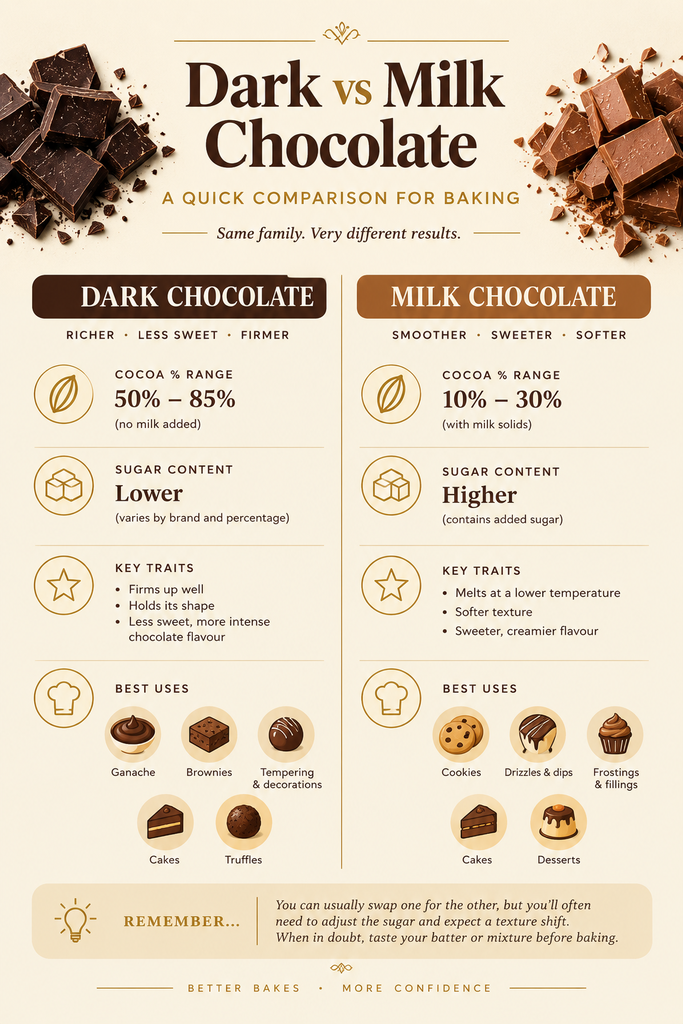
More cocoa solids means more cocoa butter, and cocoa butter is what gives chocolate its set and snap. Dark chocolate firms up harder and holds its shape better, which is exactly why it’s the standard choice for tempered work, ganache, and any bake where structure matters. Milk chocolate’s higher fat-and-sugar content from the added milk solids makes it softer at room temperature and quicker to melt, which is lovely for a gentle drizzle but a liability if you need something to hold a shape.
For the full breakdown of cocoa percentages and what they mean beyond baking specifically, our guide to types of chocolate covers that ground. This post focuses purely on what happens when you swap one for the other in a recipe.
Sweetness Balance: What Changes When You Swap
Because milk chocolate carries noticeably more sugar than dark, swapping it into a recipe written for dark chocolate will shift the overall sweetness of the finished bake, sometimes by more than you’d expect.
If you’re substituting milk chocolate into a dark-chocolate recipe, consider trimming the added sugar elsewhere in the recipe by a small amount, particularly in brownies or cakes where the chocolate itself is a major flavour component rather than a background note. Going the other way, from milk to dark, you may find the finished bake reads as more bitter or intense than intended, so a small increase in sugar (or a drizzle of something sweet on top) can bring it back into balance.
Neither direction is wrong, they’re just different desserts, and it’s worth tasting your batter or mixture before baking whenever you make this kind of swap.
Texture and Set: Ganache, Frosting, and Melted Applications
This is where the substitution question matters most, because dark and milk chocolate don’t just taste different, they set differently.
Ganache made with dark chocolate sets noticeably firmer than one made with milk chocolate, given the same cream ratio. If you swap milk chocolate into a ganache recipe written for dark, expect a softer, more spreadable result rather than a firm, slice-able one, so you may need to reduce the cream slightly to compensate. Our full ganache vs buttercream comparison goes deeper on how ganache behaves as a frosting choice generally.
Frosting and fillings follow the same logic: dark chocolate versions hold their shape at room temperature better, while milk chocolate versions stay softer and are more prone to slumping in a warm kitchen.
Melted applications (drizzles, dips, coatings) are more forgiving either way, since you’re not relying on a firm set. Milk chocolate’s lower melting point actually makes it slightly easier to work with for a smooth dip or drizzle, though both need gentle, even heat to avoid seizing.
Recipe-by-Recipe Guidance
Different bakes lean on chocolate for different jobs, so here’s how the swap plays out format by format.
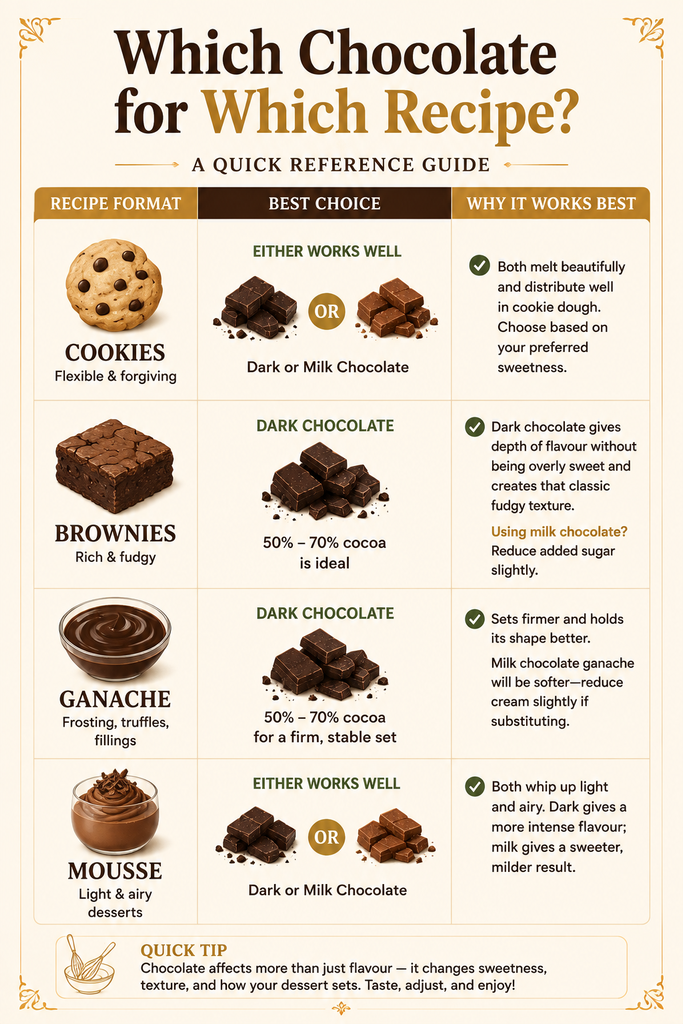
- Cookies: Either works well. Milk chocolate chips give a sweeter, more classic cookie; dark chocolate chunks give more contrast against a sweet dough. This is the most forgiving swap on this list.
- Brownies: Dark chocolate is the standard for a reason, it gives brownies their characteristic depth without becoming cloying. Milk chocolate brownies are workable but noticeably sweeter, so trim the added sugar if you go this route.
- Ganache: Dark chocolate is more reliable for a firm, pipeable, or slice-able ganache. Use milk chocolate if you specifically want a softer, sweeter, more mellow result.
- Mousse: Dark chocolate mousse holds its whipped structure better and reads as more sophisticated in flavour. Milk chocolate mousse is softer and sweeter, which can be exactly what a recipe wants for a lighter, kid-friendly dessert.
When Not to Substitute
There are a few situations where swapping chocolate types isn’t a simple adjustment, and it’s worth knowing them before you commit a whole batch of ingredients.
Delicate tempering work is the clearest case. Dark and milk chocolate temper at slightly different temperature ranges because of their different fat and milk solid content, so swapping mid-recipe in a tempering project (chocolate shells, bark, dipped confections) can lead to a chocolate that never sets with the right snap or sheen. If tempering is new to you, our step-by-step tempering guide is worth reading before you experiment with substitutions, and if something’s already gone wrong, our guide to fixing seized chocolate can help rescue it.
Recipes where cocoa percentage is load-bearing to the structure are the other case. Some recipes, especially precise European-style entremets or certain traditional tortes, are formulated around a specific cocoa percentage doing specific structural work. Swapping chocolate type in those recipes is more likely to change the outcome significantly rather than just the sweetness, so treat those as recipes to follow closely rather than adapt freely.
A Simple “If You Have Y” Framework
If your recipe calls for dark chocolate but you only have milk chocolate on hand, or vice versa, here’s the quick version.
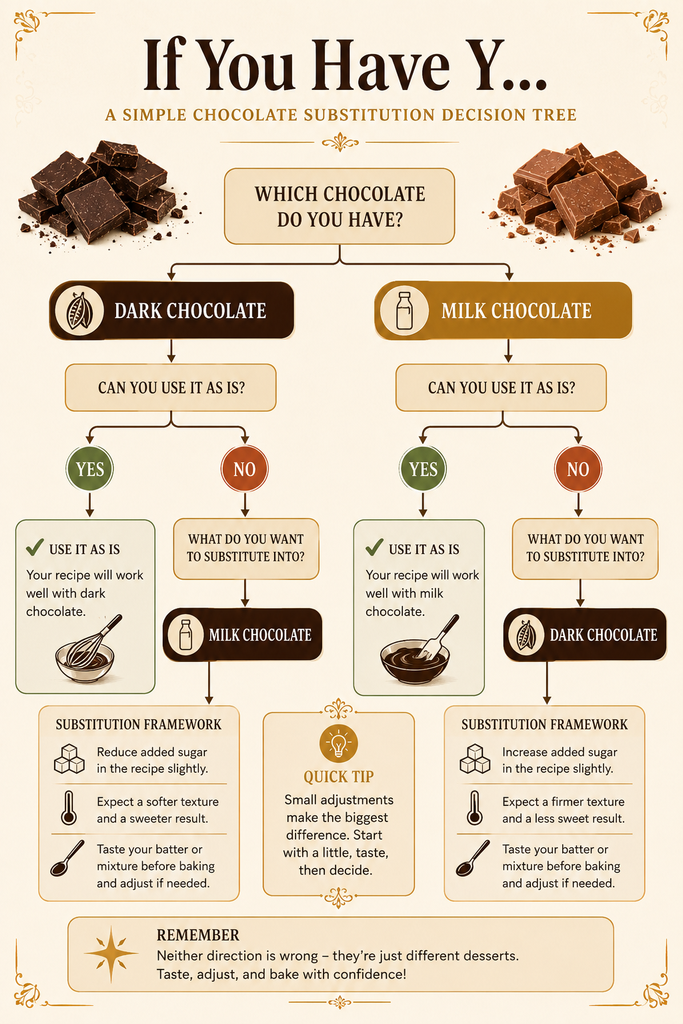
Recipe calls for dark, you have milk: Fine for cookies and most melted applications. For ganache, brownies, or frosting, expect a sweeter, softer result, and consider trimming added sugar slightly.
Recipe calls for milk, you have dark: Fine for cookies. For anything meant to be soft and mellow (a mild mousse, a gentle drizzle), expect a more intense, less sweet result, and consider adding a touch more sugar to compensate.
Either direction, for tempered or structurally precise work: Don’t substitute without testing a small batch first, since the outcome is harder to predict.
None of this is about one chocolate being “better” than the other, they’re simply built for different jobs, and knowing which job you’re doing is what makes the swap successful.
FAQs
Can I use milk chocolate instead of dark chocolate in brownies? Yes, but the brownies will be noticeably sweeter and slightly softer in texture. Trimming the recipe’s added sugar by a small amount helps balance this.
Does dark chocolate need less sugar in a recipe? Not automatically, but recipes written specifically for dark chocolate often already account for its lower sweetness elsewhere in the ingredient list, which is part of why a straight swap can throw off the balance.
Which chocolate is better for chocolate ganache? Dark chocolate gives a firmer, more reliable set for slicing or piping. Milk chocolate gives a softer, sweeter ganache that’s better suited to a looser filling or drizzle.
Is it fine to mix dark and milk chocolate in one recipe? Yes, this is a common way to land in between the two, particularly for ganache or frosting where you want more sweetness than straight dark but more structure than straight milk.