As an Amazon Associate I earn from qualifying purchases and sometimes recommend products from other sellers at no extra cost to you. For more details see my disclosure policy and privacy policy.
Most of us have tried the same experiment at some point: scoop out a bit less sugar than the recipe calls for and hope for the best. Sometimes it works. Sometimes the cake comes out pale, dry, and oddly dense, and you’re left wondering what went wrong.
The truth is that sugar is not just doing sweetness duty in your batter. It is holding onto moisture, softening the crumb, feeding browning, and helping trap air. Cut it carelessly and one or more of those jobs goes unfilled. Cut it with a plan, though, and you can trim a meaningful amount of sugar from most bakes without anyone noticing the difference. Below is the formula we use to work out how much to cut, what to add back, and which recipes should be left well alone.
The formula below works for the categories most home bakers actually reach for often: cakes, quick breads, and cookies. It will not turn a meringue into a low-sugar bake, and it will not make a caramel taste the same with half the sugar, so we’ll flag those limits clearly rather than pretend they don’t exist.
What Sugar Is Actually Doing in Your Batter
Before you touch a recipe, it helps to know exactly what you would be taking away. Sugar contributes to baking in four main ways:
- Moisture retention. Sugar is hygroscopic, meaning it attracts and holds onto water. That is a big part of why a well-sugared cake stays soft for days while a low-sugar one dries out by the next morning.
- Tenderness. Sugar interferes with the way flour proteins and egg proteins bond together. Less bonding means a softer, more delicate crumb. Pull sugar out and that structure tightens up, which is why over-reduced bakes can turn tough or gummy.
- Browning. The golden crust on a cookie or the deep colour on a loaf comes largely from sugar reacting with proteins and heat (the Maillard reaction) and from sugar caramelising on its own. Less sugar generally means a paler, less flavourful crust.
- Volume and spread. When you cream butter and sugar together, the sugar crystals cut tiny air pockets into the fat, which expand in the oven and lighten the crumb. Sugar also controls how much cookies spread, since it softens the dough as it melts during baking. For more on why this step matters so much, see our guide on how to cream butter and sugar.
None of this means sugar can’t be reduced. It means every cup you remove is pulling double or triple duty, so a workable plan replaces what it can and accepts trade-offs where it can’t.
How Far You Can Push It, by Bake Type
Reduction ceilings vary a lot depending on what you are baking, mostly because some bakes lean on sugar for structure far more than others do.
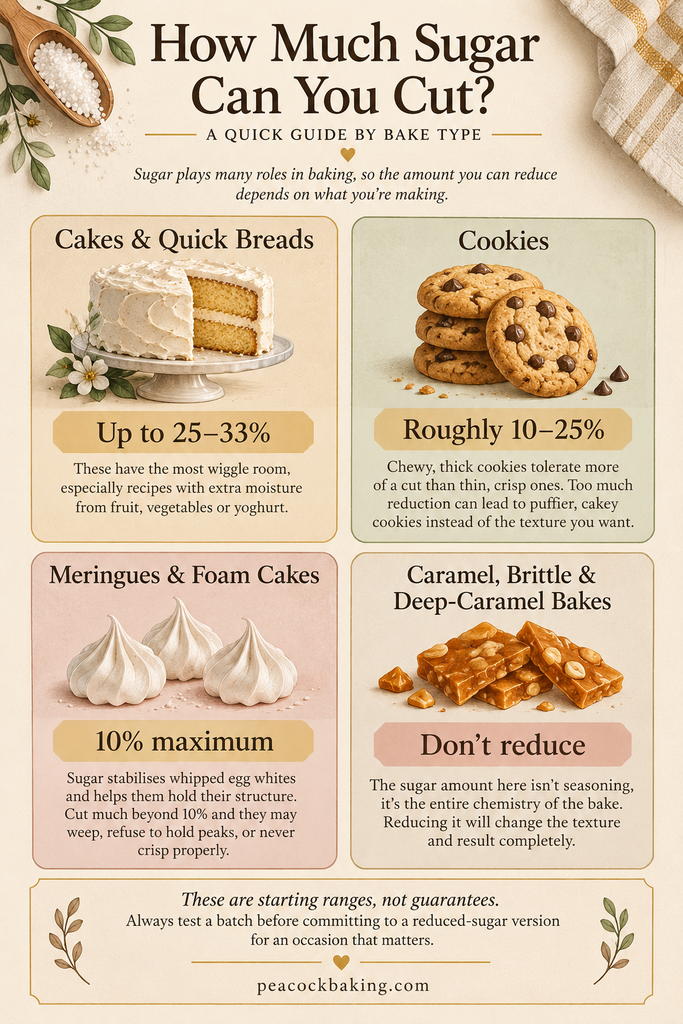
- Cakes and quick breads: up to 25-33%. These have the most wiggle room, especially banana bread, carrot cake, muffins, and other recipes with moisture already coming from fruit, vegetables, or yoghurt. Start around a 10% cut and work up from there.
- Cookies: roughly 10-25%, depending on the style. Chewy, thick cookies tolerate more of a cut than thin, crisp ones, since sugar is what makes crisp cookies spread and shatter properly. Pull too much and you get a puffy, cakey cookie instead of the one you meant to bake.
- Meringues and foam cakes: 10% maximum, and often none at all. Sugar stabilises whipped egg whites and helps them hold their structure as they dry or bake. Cut much beyond 10% and meringue can weep, refuse to hold peaks, or never crisp properly.
- Caramel, brittle, and anything relying on deep caramelisation: don’t reduce. The sugar amount there is not seasoning, it is the entire chemistry of the bake.
Treat these as starting ranges, not guarantees. Always test a batch before committing to a reduced version for an occasion that matters.
The Formula: What to Cut and What to Add Back
Here is the working method, per cup of sugar in the original recipe.
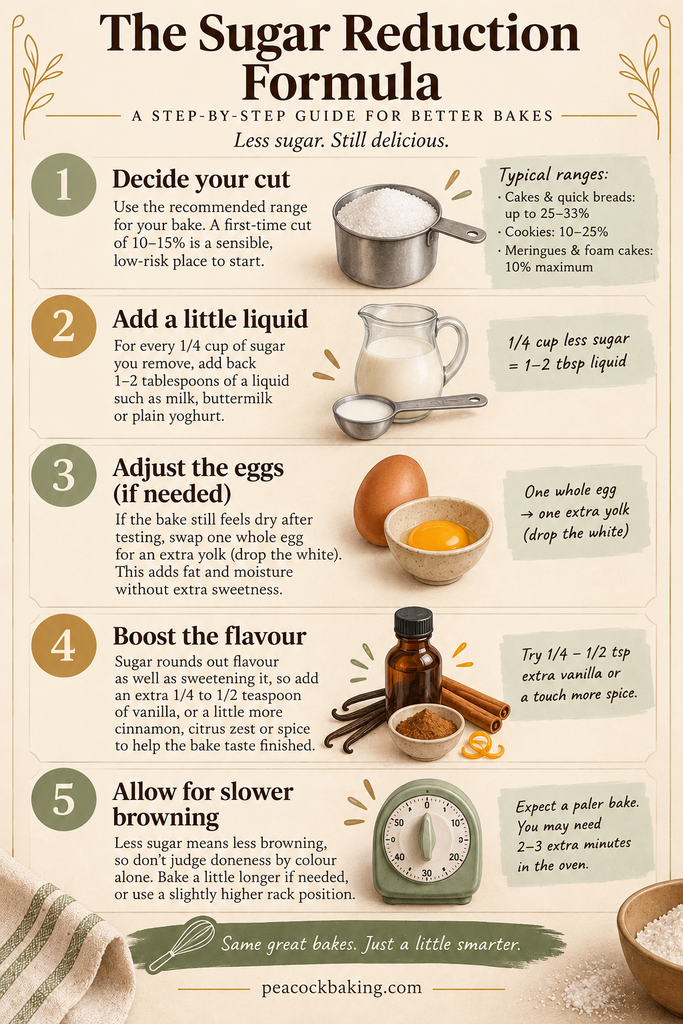
- Decide your cut based on bake type. Use the ranges above. A first-time cut of 10-15% is a sensible, low-risk place to start for almost anything.
- Replace part of the lost volume with a liquid, not another dry ingredient. For every 1/4 cup of sugar you remove, add back roughly 1-2 tablespoons of a liquid such as milk, buttermilk, or plain yoghurt. This is not a sugar substitute, it is simply putting back the moisture sugar would have held onto.
- If the bake still feels dry after your test batch, adjust the egg ratio. Swapping one whole egg for an extra yolk (drop the white) adds fat and moisture without adding sweetness, which helps compensate for the tenderising effect you lost.
- Add a small amount of vanilla or spice. Sugar rounds out flavour as well as sweetening it, so an extra 1/4 to 1/2 teaspoon of vanilla, or a touch more cinnamon or citrus zest, helps the bake taste “finished” even with less sugar in it.
- Expect a slightly paler bake and bake a touch longer if needed. Less sugar means less browning, so don’t judge doneness by colour alone. An extra 2-3 minutes in the oven, or a slightly higher rack position, can help close the gap.
Because you are often cutting an awkward amount like “3/4 cup minus 2 tablespoons,” weighing your sugar rather than eyeballing it in a measuring cup makes this whole process far more consistent, and it is worth getting comfortable with measuring ingredients properly if you plan to make a habit of adjusting recipes.
Worked Example: A Standard Vanilla Cake
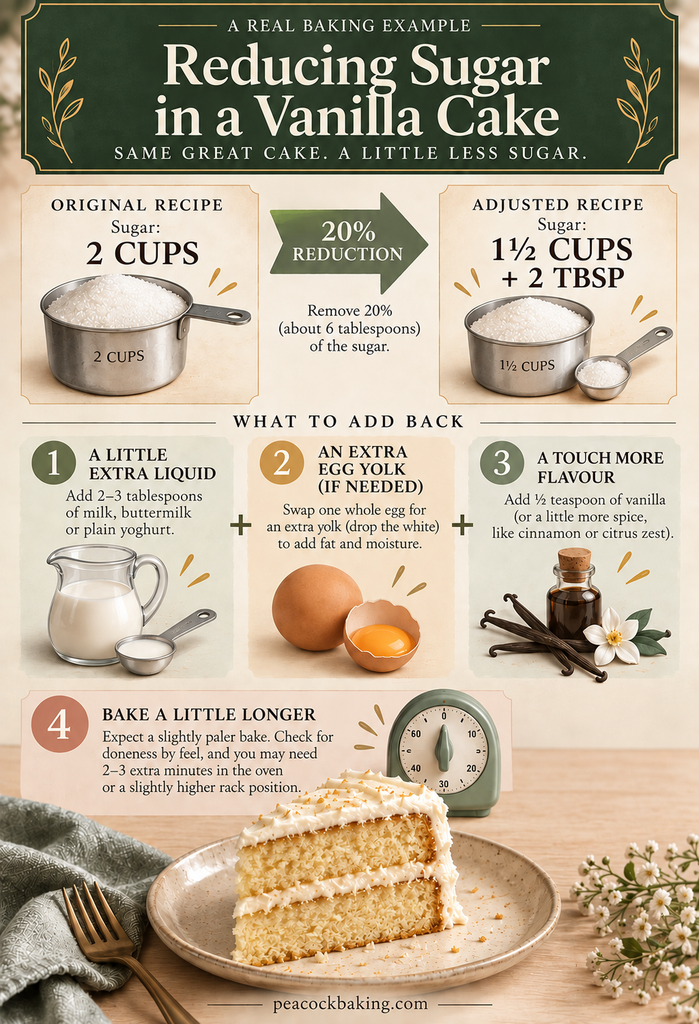
Take a basic two-layer vanilla cake that calls for 2 cups of granulated sugar. Cakes sit at the generous end of the reduction range, so here is how a 20% cut plays out.
- Original: 2 cups sugar
- Reduced: 1½ cups plus 2 tablespoons sugar (roughly a 20% cut)
- Add back: 2-3 tablespoons of milk or plain yoghurt, to replace the moisture the missing sugar would have held
- Adjust: swap one whole egg for one egg yolk if the crumb feels tight in your test bake
- Flavour: add an extra 1/2 teaspoon of vanilla extract
- Bake: check doneness a couple of minutes past the original time, since the top will colour more slowly
The result is a cake that is noticeably less sweet, still moist, and only slightly paler on top, which frosting or a dusting of icing sugar covers easily. If you bake this kind of layer cake often, a matched set of 8-inch round cake pans makes it much easier to get two even layers that rise and bake at the same rate, which matters more than usual when you are already adjusting the recipe.
The same formula applies to cookies, just with a smaller cut. Take a chocolate chip cookie recipe calling for 1 cup of brown sugar and 1/2 cup of granulated sugar. A 15% cut takes the brown sugar down to about 3/4 cup plus 1 tablespoon, with the granulated sugar left as is, since brown sugar carries most of the moisture and chew in this style of cookie. Add back a teaspoon of milk if the dough feels dry, and expect slightly less spread, so flatten the dough balls a touch more than usual before baking.
Where This Doesn’t Work Well
Some bakes simply don’t have room to give. Delicate cookies that depend on spread and a thin, crisp structure, such as lace cookies or classic snap-style gingersnaps, rely on sugar melting fully during baking to get their texture. Cut the sugar and they turn puffy and soft instead of thin and crisp.
Meringue-based bakes, macarons, and pavlova are similarly unforgiving, since sugar is what stabilises the whipped egg whites into a foam that can actually hold its shape. Anything where caramelisation is the whole point, like brittle, toffee, or a classic crème brûlée topping, also can’t be reduced without losing the dish entirely. In all of these cases, the honest answer is to leave the sugar as written and look elsewhere for a lighter option, or accept the recipe for the occasional treat it is.
Reducing Sugar vs Swapping It Out
Everything above is about using less sugar while keeping the same sugar. That’s a different approach from swapping granulated sugar for a substitute sweetener, which changes the chemistry in its own way and comes with its own set of adjustments around moisture, browning, and aftertaste. If what you actually want is a full swap rather than a reduction, our guide to sugar substitutes for baking covers that route in detail, including which substitutes behave most like sugar and which need extra tweaking.
Reducing sugar is a gentler, lower-risk change precisely because you’re not introducing a new ingredient, just using less of the one the recipe already trusts. Start with a small cut, keep notes on what you changed, and you’ll land on a version of your favourite bakes that suits your taste without a single trip to a special aisle.