
As an Amazon Associate I earn from qualifying purchases and sometimes recommend products from other sellers at no extra cost to you. For more details see my disclosure policy and privacy policy.
You’re halfway through mixing a cake batter when you reach into the cupboard and realise you’ve grabbed the wrong tin. Is it baking powder or baking soda? Are they the same thing? Can you swap one for the other? If any of that sounds familiar, you are not alone — this is one of the most common points of confusion in baking, even for people who have been at it for years.
The good news is that once you understand what each one actually does, it all clicks into place. This guide covers the science (don’t worry, it’s painless), the practical differences, and exactly when to use each one — so you can bake with confidence and stop second-guessing the label on the tin.

What Is Baking Soda?
Baking soda is pure sodium bicarbonate — nothing else. It’s a white, alkaline powder, and on its own, it doesn’t do much at all. The magic happens when it comes into contact with both moisture and an acid. That reaction produces carbon dioxide gas, which forms bubbles in your batter and makes it rise.
The acids that trigger this reaction are probably already in your recipes: buttermilk, yogurt, sour cream, brown sugar, molasses, honey, natural cocoa powder, citrus juice, and vinegar are all common examples. As soon as baking soda meets one of these ingredients and some liquid, the reaction begins — which is why you generally want to get an acidic batter into the oven fairly quickly once it’s mixed.
Baking soda is also known as bicarbonate of soda or just bicarb, especially in UK recipes. If you see either of those names, they’re all the same thing. It’s significantly more powerful than baking powder — roughly three to four times stronger by weight — so recipes typically call for much smaller amounts, often just a quarter teaspoon per cup of flour.
What Happens If You Use Too Much
Too much baking soda, or not enough acid to neutralise it, leaves your baked goods tasting soapy, metallic, or bitter. You might also notice excessive browning on the outside before the inside is cooked through. This is why precision matters: if a recipe specifies a quarter teaspoon, resist the urge to add more in the hope of a bigger rise. It usually backfires.
What Is Baking Powder?
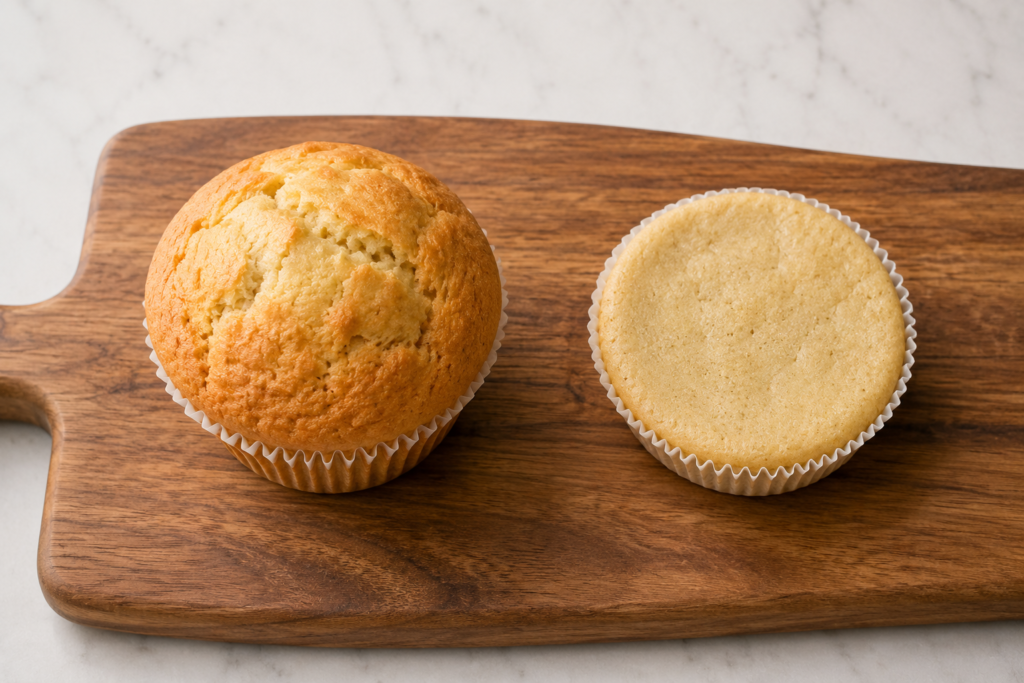
Baking powder is what’s known as a complete chemical leavener. Unlike baking soda, it contains everything it needs to work: baking soda (the base), one or more powdered acids (often cream of tartar or monocalcium phosphate), and a starch — usually cornstarch — to keep the mixture dry and stable in the tin. Because the acid is already built in, baking powder just needs moisture to activate.
Most modern baking powders are double-acting, which means they produce gas in two stages. The first release happens when the powder meets liquid in the batter. The second, larger release happens when the batter hits oven heat and a different heat-activated acid kicks in. This two-stage process is actually very forgiving — your batter can sit for a few minutes before going in the oven without going flat, which is helpful when you’re juggling multiple things at once.
You can also make a simple homemade baking powder by combining one part bicarbonate of soda with two parts cream of tartar by volume. This works as a single-acting version and is handy in a pinch.
The Science: How They Both Make Baked Goods Rise
At their core, both baking soda and baking powder rely on the same chemistry: an acid-base reaction that produces carbon dioxide gas. The batter traps those gas bubbles in its structure, and when the heat of the oven causes them to expand, the whole thing rises and sets into something light and tender.
The key difference is simply where the acid comes from. With baking soda, the acid has to come from other ingredients in the recipe. With baking powder, the acid is already mixed in, so it can do its job even in a plain batter with no acidic ingredients at all. That’s the whole distinction — and once you understand it, knowing which one to reach for becomes much more intuitive.
If you want to understand the broader mechanics of how baking works, the guide to baking basics and techniques is a great place to start.
Baking Powder vs Baking Soda: The Key Differences
Here’s a clear side-by-side look at how they compare.
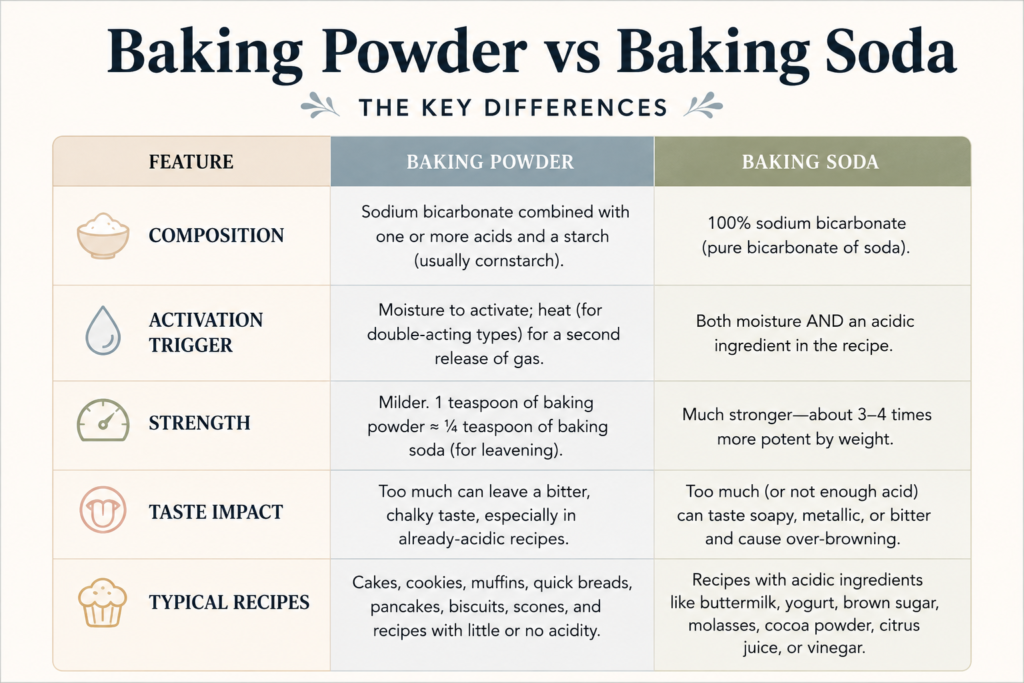
Composition: Baking soda is 100% sodium bicarbonate. Baking powder is sodium bicarbonate combined with one or more powdered acids and a starch to stabilise it.
Activation: Baking soda needs both moisture and an acidic ingredient in the batter. Baking powder just needs moisture (and heat, for double-acting types) because the acid is already present.
Strength: Baking soda is significantly more potent. As a rough guide, one teaspoon of baking powder is equivalent to about a quarter teaspoon of baking soda for leavening purposes, though recipes are always balanced for flavour as well as lift.
Taste impact: Too much baking soda, or an imbalance with the acid in a recipe, produces a soapy or metallic flavour and can cause over-browning. Too much baking powder can leave a bitter, chalky taste, especially in recipes that are already acidic.
Typical use: Baking soda suits recipes that contain acidic ingredients. Baking powder is for recipes with little or no acidity.
When to Use Baking Soda
Reach for baking soda when your recipe already contains something acidic. The most common examples are:
- Buttermilk, yogurt, or sour cream
- Brown sugar, molasses, or honey
- Natural (not Dutch-process) cocoa powder
- Citrus juice or zest
- Vinegar
In these recipes, the baking soda isn’t just providing lift — it’s also neutralising some of the acidity, which balances the flavour and affects texture and browning. Baking soda encourages the Maillard reaction (the process that creates golden colour and deeper flavour), which is why classic chocolate chip cookies, gingerbread, and banana bread often rely on it.
A good example: banana walnut muffins use baking soda because the ripe bananas bring enough natural acidity and sweetness to activate it properly. The result is a good rise and a warm, golden colour that baking powder alone wouldn’t produce in the same way.
The key is proportion. Use just enough baking soda to neutralise the acid in the recipe, and no more. The formula is usually set for you in a well-tested recipe — trust it.
When to Use Baking Powder
Baking powder is the go-to for recipes that don’t contain an obvious acidic ingredient. Think simple vanilla cakes, basic cupcakes, scones, some quick breads, and plain pancakes. Without an acid in the batter, baking soda would have nothing to react with, so baking powder steps in to provide the lift on its own.
Because double-acting baking powder releases its gas in two stages, it also gives you a little more flexibility with timing. A batter made with baking powder can sit briefly while you heat your pans or preheat the oven without losing all its lift — useful when you’re baking a large batch or working at a relaxed pace.
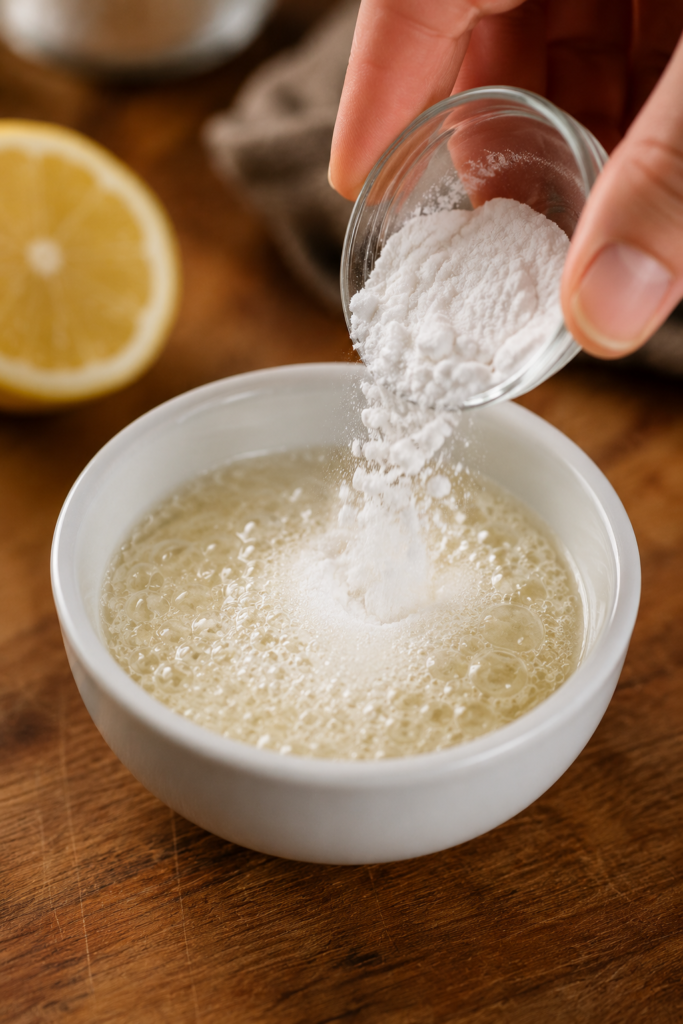
A good habit worth building: check the expiry date on your baking powder regularly. Unlike baking soda, which lasts well when stored properly, baking powder loses its potency over time once opened. To test it, stir a teaspoon into hot water — if it fizzes vigorously, it’s still active. If not, it’s time to replace it.
What If a Recipe Uses Both?
This is one of the questions that confuses people most. If baking powder contains baking soda, why would a recipe ever need both? The answer comes down to balance.
When a recipe includes acidic ingredients but also needs substantial lift, the baking powder provides the bulk of the rise while a small amount of baking soda does two things: it neutralises excess acidity to keep the flavour clean, and it encourages browning and spread. Classic examples include buttermilk pancakes, chocolate cakes made with natural cocoa, and many cookie recipes.
In these cases, the amounts of each are carefully calibrated. Swapping one for the other, or simply leaving one out, will usually change the flavour, texture, or appearance of the finished bake in ways that are hard to predict. The short version: trust the recipe.
The same principle applies when you’re making something like yellow sheet cake — the leaveners are working together to achieve a specific crumb and rise that either one alone couldn’t produce.
Can You Substitute One for the Other?
In an ideal world, you’d always have both on hand. But if you find yourself in a pinch, here’s what to know.
Substituting Baking Powder for Baking Soda
Because baking powder is weaker, you’d need roughly three times as much to match the leavening power of baking soda. Even then, you’re adding extra acid and starch to the recipe, which may affect texture and flavour. It’s workable for casual baking, but not ideal for anything where results really matter.
Substituting Baking Soda for Baking Powder
This is trickier. In theory, you’d use about a quarter as much baking soda and add an acid like cream of tartar to replicate baking powder’s effect. In practice, getting the acid balance right is difficult without testing, and the results can be flat, bitter, or oddly textured.
The safest advice: only substitute in an emergency, for something where a less-than-perfect result is acceptable. For important bakes — a birthday cake, a batch of scones for guests — keep both in the cupboard. They’re inexpensive and they last well if stored properly.
How to Test Freshness
Both products lose their potency over time, especially once opened. Stale leaveners are one of the most common and least obvious reasons a bake suddenly doesn’t rise the way it should.
To test baking soda, drop a small amount into vinegar or lemon juice. It should bubble energetically and immediately. If the reaction is slow or weak, replace it.
To test baking powder, stir a teaspoon into a cup of hot water. Strong fizzing means it’s still active. A muted response means it’s past its best.
Store both in a cool, dry place with the lid firmly closed. Keep them away from steam and humidity — placing them right next to the hob is not ideal. A good rule of thumb is to replace them every six to twelve months once opened, or sooner if the fizz test fails.
A Simple Decision Guide
Still not sure which to use? Run through this:
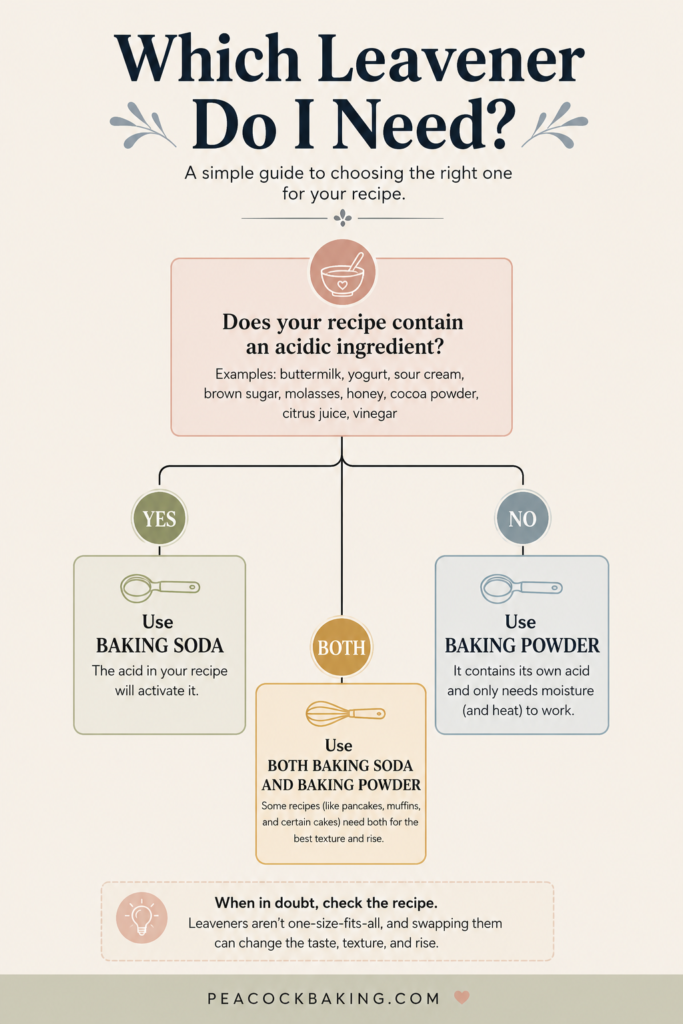
- Does your recipe contain buttermilk, yogurt, sour cream, brown sugar, molasses, honey, vinegar, citrus juice, or natural cocoa? You likely need baking soda (often alongside some baking powder).
- Does your recipe have no obvious acidic ingredients? You probably need baking powder.
- Does your recipe call for both? Keep both in and trust the formula — they’re working together.
- Tempted to substitute in a pinch? It’s possible but risky. Only do it for casual bakes, and know the result may not be quite right.
Understanding these two ingredients is one of those baking fundamentals that quietly improves everything you make. Once you know the why behind the rules, you stop second-guessing and start baking with real confidence.
If you’re building out your knowledge of baking basics, the guide to how to measure ingredients for baking is worth reading next — getting your quantities right is just as important as knowing which leavener to use. And if you want to explore what other baking ingredients can do for you, the full baking flour types guide covers another essential building block for better bakes.
Recipe FAQ
Can I use baking powder instead of baking soda? You can, but not in equal amounts. Because baking powder is weaker, you’d need roughly three times as much to match the leavening power of baking soda. Keep in mind that swapping them also changes the acid balance of the recipe, which can affect texture and flavour — so this is best reserved for casual bakes where a slightly different result is acceptable.
What happens if I accidentally use too much baking soda? Too much baking soda, especially without enough acid in the recipe to neutralise it, will leave your baked goods with a soapy or metallic taste. You may also notice excessive browning on the outside. Unfortunately there’s no easy fix once the batter is mixed — it’s best to start again if you’ve significantly over-measured.
Is bicarbonate of soda the same as baking soda? Yes, completely. Bicarbonate of soda, bicarb, and baking soda are all the same ingredient: pure sodium bicarbonate. The different names are mainly a UK vs US difference, though you’ll see all three used across English-language recipes worldwide.
Why does my recipe use both baking powder and baking soda? Recipes that call for both are usually balancing two things at once: the baking powder provides the main lift, while the baking soda neutralises excess acidity and encourages browning. The amounts are calibrated together, so it’s best not to change the ratio or leave one out.
How long does baking powder last once opened? Most baking powders stay active for six to twelve months after opening when stored in a cool, dry place with the lid tightly closed. Always do the fizz test (a teaspoon stirred into hot water should bubble vigorously) if yours has been open for a while, rather than assuming it’s still good.


