
As an Amazon Associate I earn from qualifying purchases and sometimes recommend products from other sellers at no extra cost to you. For more details see my disclosure policy and privacy policy.
We’ve all been there — you’re halfway through a recipe when you realize you’re out of eggs, or the butter you thought was in the fridge has mysteriously vanished. Before you give up or make an emergency grocery run in your apron, take a breath. Baking substitutions are more practical than most people think, and with the right swaps, your final bake can turn out just as good as — sometimes even better than — the original.
This guide breaks down the most common baking ingredients you might find yourself short on, what to use instead, and — crucially — why certain swaps work better in some recipes than others. Understanding the “why” behind substitutions is what separates a confident baker from someone who’s just guessing.
Why Baking Substitutions Aren’t One-Size-Fits-All
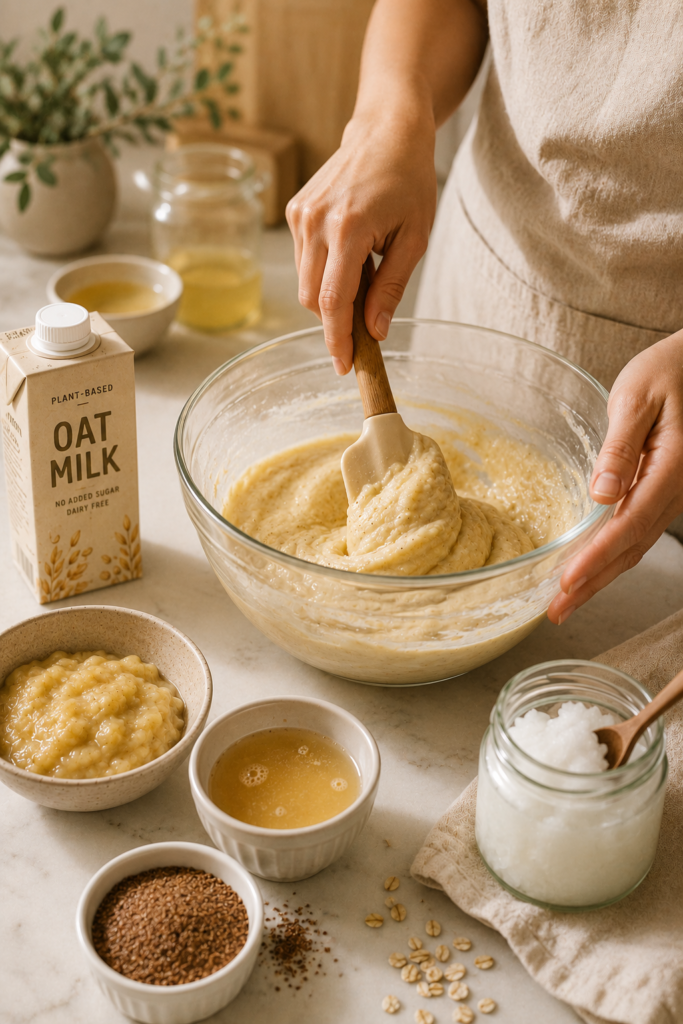
Before we jump into the swaps themselves, it helps to understand that most ingredients in baking are doing more than one job at a time. Eggs, for example, can be binding the batter together, adding moisture, providing structure, helping the bake rise, or all of the above depending on the recipe. That’s why swapping eggs in a delicate sponge cake is a very different challenge from swapping them in a batch of chunky cookies.
The same logic applies to butter, flour, and milk. Once you understand what role an ingredient plays in your specific recipe, choosing the right substitute becomes much easier. This guide is organized by ingredient so you can jump straight to what you need.
Baking substitution finder
Select the ingredient you need to replace and your recipe type to get the best swap.
Select an ingredient and recipe type above to get your best swap.
Egg Substitutes for Baking
Eggs are probably the most common ingredient people need to swap — whether due to an allergy, a vegan diet, or simply running out at the wrong moment. The key question to ask is: what is the egg doing in this recipe?
When You Need a Binder
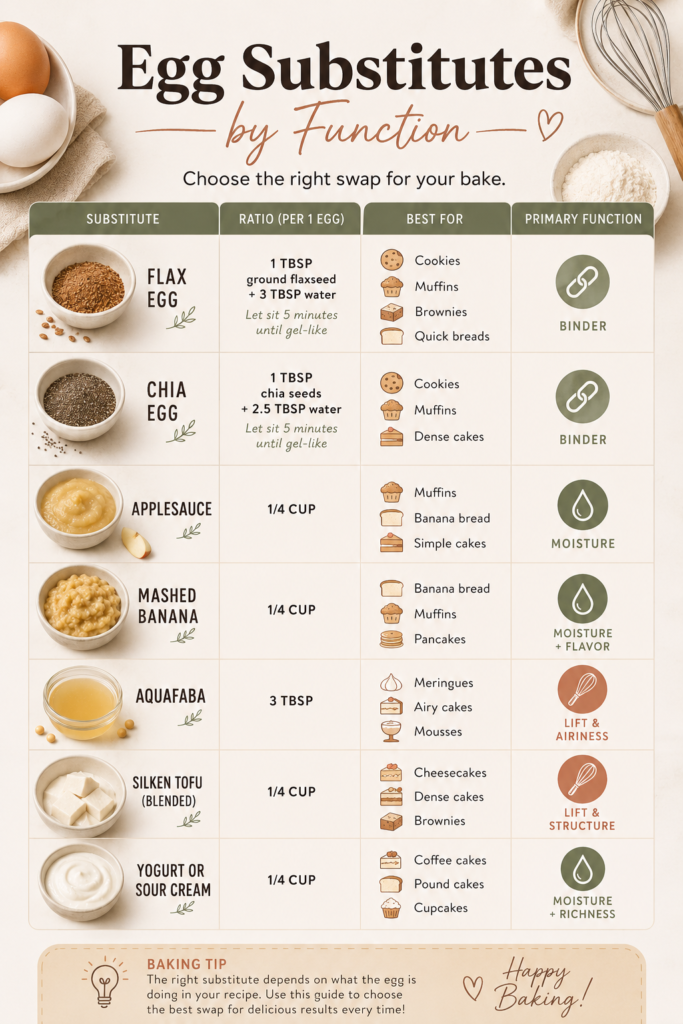
In recipes like cookies, brownies, muffins, and quick breads, eggs mainly hold everything together. For these, a flax egg is one of the most reliable swaps you can make. Mix 1 tablespoon of ground flaxseed with 3 tablespoons of water and let it sit for 5 minutes until it becomes thick and gel-like. This replaces one large egg and works beautifully in denser bakes.
Chia eggs work in exactly the same way — use 1 tablespoon of chia seeds with 2.5 tablespoons of water, again letting it gel before using. Both flax and chia eggs add a very subtle nutty flavour that’s virtually undetectable in a spiced recipe or chocolate bake.
When You Need Moisture
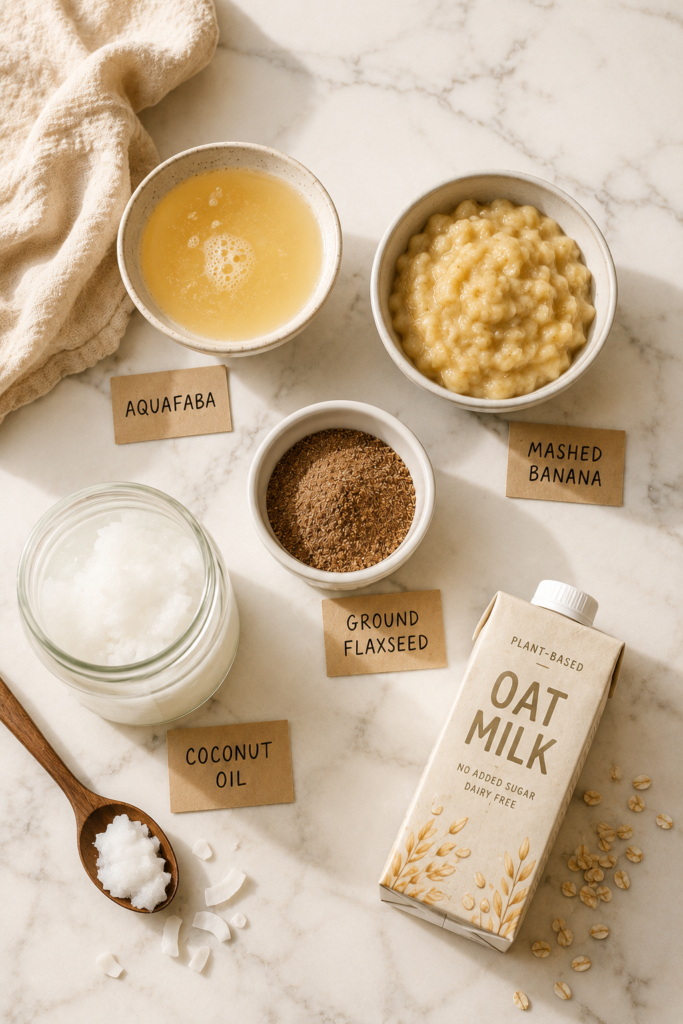
For moist, tender bakes like banana bread, muffins, and simple cakes, fruit and dairy-based swaps shine. Unsweetened applesauce is one of the best — use ¼ cup per egg. It adds moisture and a touch of natural sweetness without changing the flavour significantly. Mashed ripe banana works similarly at the same ratio, though it will lend its own flavour to the finished bake (not always a bad thing — try it in our almond chocolate banana bread).
Plain yogurt and sour cream are also excellent at ¼ cup per egg, adding richness as well as moisture. These work particularly well in coffee cakes, pound cakes, and anything with a dense, tender crumb.
When You Need Lift or Airiness
This is where substitutions get a little more technical. If an egg’s job is to help a bake rise and stay light — think soufflés, chiffon cakes, or anything that relies on whipped egg whites — aquafaba is your best bet. Aquafaba is simply the liquid from a can of chickpeas, and 3 tablespoons replaces one whole egg. It can even be whipped to stiff peaks just like egg whites, making it a genuine game-changer for vegan meringues and light mousses.
Silken tofu is another option for richer, denser bakes like cheesecakes or fudgy brownies. Use about ¼ cup of blended silken tofu per egg — it won’t add any flavour but adds a great creamy structure.
Quick Egg Substitute Reference
| Substitute | Ratio (per 1 egg) | Best For |
|---|---|---|
| Flax egg | 1 tbsp ground flaxseed + 3 tbsp water | Cookies, muffins, brownies, quick breads |
| Chia egg | 1 tbsp chia seeds + 2.5 tbsp water | Cookies, muffins, dense cakes |
| Applesauce | ¼ cup | Muffins, banana bread, simple cakes |
| Mashed banana | ¼ cup | Banana bread, muffins, pancakes |
| Aquafaba | 3 tbsp | Meringues, airy cakes, mousses |
| Silken tofu (blended) | ¼ cup | Cheesecakes, dense cakes, brownies |
| Yogurt or sour cream | ¼ cup | Coffee cakes, pound cakes, cupcakes |
Butter Substitutes for Baking
Butter contributes fat, flavour, and moisture to baked goods, and it also affects texture depending on whether it’s melted, softened, or cold. The best substitute depends on the recipe and which of those roles the butter is playing.
Oil as a Butter Swap
For cakes, muffins, brownies, and quick breads — where butter is melted or adds moisture rather than structure — neutral oil like vegetable or canola oil is the simplest swap. Use ¾ cup of oil for every 1 cup of butter called for. The reduced ratio accounts for the higher fat content in oil. The result is often an even moister crumb, though you’ll lose a little of butter’s distinctive flavour.
Coconut oil is a popular option, especially in recipes that can handle a slight coconut taste. It’s a 1:1 swap for melted butter and works brilliantly in cookies, granola bars, and chocolate bakes.
Margarine and Shortening
Margarine works as a 1:1 swap for butter in most baking recipes, making it the easiest substitution if you simply don’t have butter on hand. Look for a block-style margarine rather than a spreadable version, as the higher water content in spreads can affect the texture of cookies and pastry.
Vegetable shortening is another 1:1 swap that’s particularly useful in pie crusts and cookies. It has a higher melting point than butter, which means cookies made with shortening often hold their shape better and have a slightly crispier edge — handy if you’re making something like classic oatmeal raisin cookies and want them to keep their form.
For Richer Bakes
If you’re making something like a rich cake, frosting, or anything where butter flavour is front and centre, Greek yogurt or cream cheese can partially replace butter to add fat and creaminess while reducing overall fat content. These are typically used to replace half the butter in a recipe rather than all of it, helping maintain the right texture while lightening things up a little.
Milk and Dairy Substitutes
Running out of milk is rarely a dealbreaker in baking. Most non-dairy milks work as a 1:1 substitute in any recipe that calls for regular milk — oat milk, almond milk, soy milk, and coconut milk all work well. Soy milk tends to have the closest protein content to cow’s milk, which can make a difference in recipes that rely on that protein for structure, but in most everyday bakes, the difference is negligible.
Buttermilk Substitutes
Buttermilk is trickier because it’s not just about moisture — the acidity in buttermilk reacts with baking soda to help batters rise. If you’re out of buttermilk, the classic fix is to add 1 tablespoon of white vinegar or lemon juice to 1 cup of milk (dairy or non-dairy), stir, and let it sit for 5 minutes until it curdles slightly. This creates a good approximation that works in buttermilk pancakes, cakes, and quick breads.
Plain yogurt thinned with a little milk or water is another solid option — the tanginess and acidity are already there, so it mimics buttermilk’s effect without any extra fuss.
Heavy Cream
For recipes that call for heavy cream, full-fat coconut cream (the thick part from a refrigerated can of coconut milk) is a reliable dairy-free swap and can even be whipped. For something less rich, a mixture of whole milk and melted butter — about ¾ cup milk plus ¼ cup melted butter per cup of cream — can work in sauces and baked goods, though it won’t whip.
Flour Substitutes for Baking
Flour is one of the trickier swaps to make because different types have very different protein contents, which affects gluten development and therefore the structure of your bake. If you want a deep understanding of how different flours behave, our complete guide to baking flours covers it in detail.
All-Purpose Flour Alternatives
For most recipes, cake flour can replace all-purpose flour to create a lighter, more tender crumb — use 1 cup plus 2 tablespoons of cake flour for every 1 cup of all-purpose flour. Going the other direction, you can use bread flour in place of all-purpose, though expect a chewier, denser result as the higher protein content creates more gluten.
Oat flour is a good whole-grain alternative and can typically replace up to half the all-purpose flour in cookies and muffins. It has a mild, slightly nutty flavour and works particularly well in heartier bakes. Almond flour is popular in grain-free baking, though it behaves very differently from wheat flour — it’s denser, higher in fat, and doesn’t form gluten, so it typically works best in recipes specifically developed for it rather than as a straight swap.
Gluten-Free Flour
If you need a gluten-free option, a 1:1 gluten-free flour blend — usually a mix of rice flour, tapioca starch, and potato starch — will work in most standard recipes without much adjustment. These blends are specifically formulated to mimic all-purpose flour, so they’re the most reliable option for straightforward substitution.
One thing to keep in mind: gluten-free batters and doughs often benefit from a short resting period before baking, which gives the starches time to hydrate fully. This helps prevent a gritty texture in the finished bake.
Baking Powder and Baking Soda Substitutes
These two leaveners are different things and not directly interchangeable, though they’re both responsible for helping bakes rise. Baking powder contains both an acid and a base, while baking soda is pure base and needs an acid in the recipe to activate.
If you’ve run out of baking powder, you can make your own by combining ¼ teaspoon of baking soda with ½ teaspoon of cream of tartar — this equals 1 teaspoon of baking powder. Alternatively, if your recipe already contains an acidic ingredient (like buttermilk, yogurt, or brown sugar), you can replace 1 teaspoon of baking powder with ¼ teaspoon of baking soda.
For baking soda, the swap is trickier. You can use baking powder in its place, but you’d need about 3 times the amount (so 1 teaspoon baking soda = 3 teaspoons baking powder). The downside is that baking powder has a slight metallic taste in large quantities, and it may also increase browning. In a pinch, beaten egg whites can also help add lift in recipes that don’t rely too heavily on chemical leavening.
Sugar Substitutes for Baking
Sugar does more in baking than just add sweetness — it contributes to browning, tenderness, and moisture retention, so substitutions can affect texture as much as flavour.
Swapping White Sugar
Brown sugar can replace white sugar 1:1 in most recipes and will add a hint of molasses flavour and extra moisture to the finished bake. This is particularly lovely in cookies and quick breads. Honey and maple syrup work too, but they’re liquid sweeteners, so you’ll need to reduce other liquids in the recipe by about 3 tablespoons per cup of honey or maple syrup, and add a small pinch of baking soda to balance the acidity.
Coconut sugar is perhaps the most direct swap for refined white sugar — it’s granular, slightly less sweet, and has a mild caramel flavour. It can be used 1:1 in most recipes and works especially well in anything chocolate-based.
Reducing Sugar
If you’re trying to reduce sugar rather than replace it entirely, you can generally cut the sugar in most recipes by up to 25% without dramatically affecting the final result. Going beyond that starts to affect texture, moisture, and sometimes browning.
A Few Final Tips for Successful Baking Substitutions
Making substitutions successfully comes down to understanding a few simple principles. First, try not to make multiple swaps in the same recipe at once — each change introduces a new variable, and troubleshooting becomes much harder. Start with one substitution, see how it affects the result, and adjust from there.
Second, remember that texture and moisture content often shift with substitutions even when flavour doesn’t. If a recipe seems too wet or too dry with your swap, adjust with an extra tablespoon of flour or liquid accordingly. And finally, baking is always a little bit of an experiment — even experienced bakers test and iterate. Understanding why each ingredient is there gives you the confidence to adapt on the fly, and that’s where baking really starts to get fun.
If you’re just getting started and want to build a more solid foundation before experimenting with substitutions, our post on how to measure ingredients correctly is a great place to begin — getting the basics right makes every other step easier.
Continue Baking
- The Complete Guide to Baking Flours: Types, Uses & Substitutions — understand how different flours behave before you start swapping them
- How to Measure Ingredients for Baking (The Right Way) — accurate measuring makes every substitution more predictable
- Baking Basics: Essential Kitchen Tools Every Beginner Baker Needs — make sure you have the right tools before you start
- Understanding Baking Temperatures: Your Complete Oven Guide — another key variable that affects how substitutions perform
- Coconut Flour Chocolate Chip Cookies — a great recipe to try if you’re experimenting with alternative flours
Have you tried any of these substitutions in your own baking? I’d love to hear which swaps have worked well for you — or any disasters that taught you something new! Drop a comment below.
Want more baking tips and recipes straight to your inbox? Sign up for the Peacock Baking newsletter and never miss a post.


